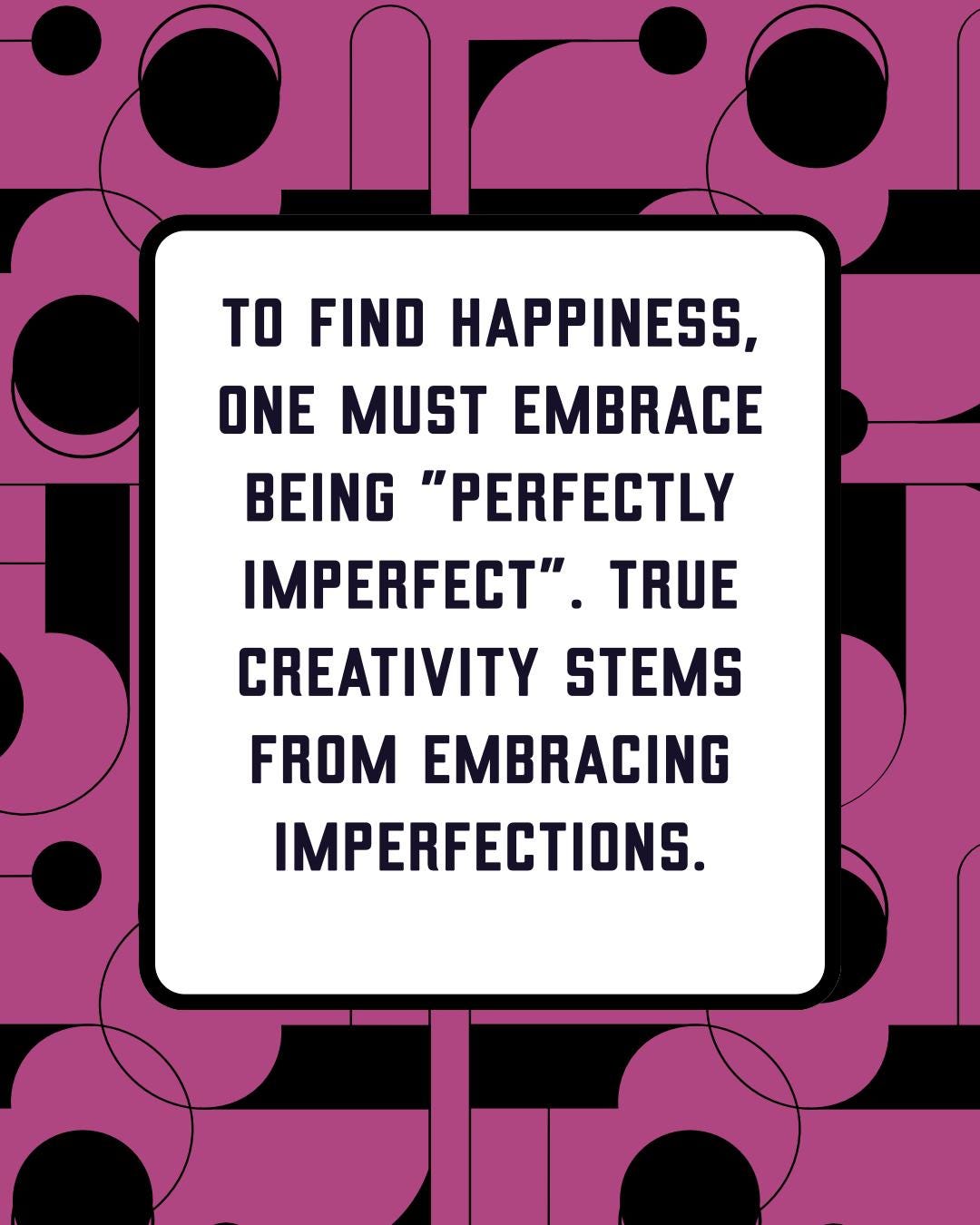
When Things Go Sideways: Perfectionism, ADHD & Reframing Failure
PART ONE: Why getting it wrong doesn’t mean you’ve failed and how self-compassion and growth mindset can help you move forward.
I have been thinking a lot about what happens when something doesn’t go the way we thought it would. The truth is, I think about it because I have lived through my own experiences of rebuilding after disappointment and setbacks. Some of the biggest have involved challenges to my self-concept, pursuing a late-in-life career change, and reconciling the impact that undiagnosed ADHD had on my overall sense of self. The struggle is real out here. I’ve also spoken with many people who have their own version of these experiences, and I began to notice how much we have in common. So I decided to create a three-part series to unpack some of these challenges, explore how we can grow from them, and share a few of the coaching tools that have helped me and others along the way.

Photo: This is an example of a moment when I was devasted by not reaching a goal after a ton of hard work taboot. My studio one final pin-up. The culmination of so much learning and growing. I was so overwhelmed but proud of what I had created, but I wasn't able to get all my drawings done on time. I felt defeated. I did finish them and turn them in. I learned so much by taking the time I needed to get my head around executing my final drawings. I didn't give up and that was what mattered in the long run. I also passed the course, but dang I really wanted to knock it out of the park. Who can relate?
Our worth also doesn’t have to be tied to our job title, marital status, social circle, bank account, accomplishments, or status. These things can be meaningful and important, but they are also subject to change. One day everything can feel secure and the next—BOOM!—life changes the equation. Knowing who we are beneath those external circumstances gives us something steadier to stand on when they shift. What does success, happiness, or fulfillment actually mean to you? Maybe it is a career you love. Maybe it is a happy home, time with family and friends, creative freedom, good health, or simply having a life that feels like your own. It’s your party, Boo. You choose the theme.
Of course, choosing our own path doesn’t mean we won’t fall down. We will. Sometimes spectacularly. We will make questionable decisions, get things wrong, change our minds, and occasionally fail so thoroughly that we wonder whether someone should hand us a medal for participation in the Emotional Olympics. But falling down doesn’t have to be the end of the story. We get to decide what we do next, and sometimes putting things back together means rebuilding them differently than they were before.
That is where creativity becomes such a powerful way of approaching life. The roadmap in our heads isn’t always the roadmap we end up following. Sometimes it needs a few adjustments. Sometimes it needs a completely different perspective, better resources, or a little more time. And occasionally, we have to scrap the whole thing and start over. None of that means the journey is over. It means we’re working with new information.
Each day gives us another opportunity to pause, reconsider, pivot, and think beyond the box that once held our expectations about who we were, what we were supposed to do, and how things were supposed to turn out. Perfectionism can make that incredibly difficult. The need to get it right, avoid mistakes, or appear like we have everything figured out can keep us from experimenting, being vulnerable, pursuing creative ideas, changing direction, or even becoming the person we genuinely want to be.
And if ADHD is part of your experience, welcome to the Emotional Olympics, where apparently someone added several events without bothering to tell us. 😂 Overwhelm, difficulty shifting gears, twelve competing thoughts arriving simultaneously, forgetting what seemed completely obvious five minutes ago, and the classic ADHD mental highlight reel where one disappointing moment somehow becomes a full-length feature film about every mistake you’ve ever made on repeat.
If you’ve experienced that, you are not alone. And here’s where the pause matters.
Those mental movies are telling stories about the past. You don’t have to solve your entire history in the middle of today’s disappointment. Take a breath. Let your nervous system settle. Come back to what is actually happening right now.
The past may have shaped you, but it doesn’t get to make every decision about your present.
When Perfectionism Looks Like Protection
There is something particularly sneaky about perfectionism because it often disguises itself as ambition, high standards, responsibility, or simply wanting to do things well. There is absolutely nothing wrong with caring about quality. It is natural to want to create beautiful, meaningful, thoughtful, excellent work. For many of us, caring deeply about what we do is part of what makes us who we are.
The trouble begins when doing something well becomes tangled up with believing we have to get it right, especially when we start believing we have to get it right the first time. That is where perfectionism can quietly shift from excellence into protection. Instead of simply wanting to do our best, we may begin trying to protect ourselves from the feelings that can come with making a mistake: embarrassment, disappointment, judgment, rejection, or the possibility that we aren’t as capable as we hoped we were.
Elizabeth Gilbert has described perfectionism as “fear in fancy shoes,” which I think is an almost painfully accurate description. Underneath all those high standards and carefully considered expectations, there can be a much more vulnerable question: What if I try and discover I’m not as capable as I thought I was?
That question can take many forms: What if other people see me struggle? What if I make the wrong choice? What if I disappoint someone? What if it doesn’t work? What if I don’t understand what everyone else seems to understand? What if I try really hard and still can’t make it work? And perhaps the most painful version: What if it doesn’t work and I decide that means something bad about me?
That last question can be particularly powerful because once our performance becomes connected to our sense of worth, a mistake isn’t simply a mistake anymore. It feels personal.
When ADHD Adds Another Layer
For those of us with ADHD, this can become even more complicated. ADHD isn’t simply about being distracted or having trouble paying attention. It can affect the way we manage attention, motivation, time, organization, working memory, task initiation, shifting between tasks, and competing demands. These challenges don’t necessarily show up in the same way every day, either. Stress, fatigue, interest, environment, and the demands of the moment can all influence how accessible our abilities feel. That inconsistency can be particularly confusing. You may know you are capable of doing something because you’ve done it before, perhaps even exceptionally well. Then, on another day, the exact same type of task can feel almost impossible to begin, organize, or complete. Over time, that experience can affect the way we see ourselves. When you don’t have an explanation for why something that should be manageable suddenly feels impossible, it is very easy to turn the confusion inward and assume you simply need to try harder.
I know this because I have struggled with aspects of perfectionism for most of my life. It took me many years to understand where some of it came from, how it was keeping me small in ways I didn’t recognize, and how ADHD was also playing a role in my experience. For a long time, I didn’t know I was experiencing ADHD burnout. I simply thought I wasn’t managing things well enough. When you don’t understand why something that seems manageable for everyone else suddenly feels impossible for you, it can be incredibly easy to turn that frustration into self-criticism.
Perfectionism can become a form of armor. If I can just do everything correctly, maybe I can prevent that feeling of falling behind. If I anticipate every possible problem, maybe I won’t fail. If I make everything perfect, maybe no one will notice how hard this actually feels. It can feel like a way of staying safe when underneath it all, we are afraid of being exposed as somehow not enough.
Learning to Make Room for a Different Way of Thinking
Going back to school challenged a lot of this for me. For the first time in a long time, I found myself genuinely afraid of not doing things correctly. I worried about interpreting something differently than expected, making the wrong choice, failing, or simply not being able to succeed at the level I knew I was capable of. There was a lot to unpack there.
I had to learn to advocate for what I needed instead of beating myself up for being different. I had to remind myself that different minds bring different ways of seeing, thinking, designing, questioning, and solving problems, and those differences are not inherently deficits. In fact, those differences are often exactly what creative fields need.
Knowing that intellectually doesn’t automatically make being different easy, though. Sometimes other people don’t understand the way your brain works, and sometimes you don’t understand it yourself. The way you learn or solve a problem may not fit neatly into the expected process. After years of feeling like you’re supposed to fit yourself into someone else’s definition of “doing it right,” perfectionism can become a way of protecting yourself. I found that out firsthand.
I had to learn how to compromise, advocate for myself, pivot, and push past the illusion that everything needed to be perfect before it could be considered good. I had to leave room for designs to evolve, grow, and change. And, perhaps most painfully for an architecture student, I had to learn to draw without an eraser.
Mind bending. 😂
And also incredibly liberating.
There is something powerful about allowing yourself to make a mark, look at it, learn from it, and continue instead of immediately trying to erase the evidence that you were figuring something out. Sometimes the line you thought was a mistake becomes part of the solution. Sometimes the thing you thought needed to be erased gives you information about where the design wants to go. And sometimes, I think, we need to offer ourselves that same permission.
When the Volume Gets Turned Up
There is another piece of the ADHD conversation that deserves attention here: emotional regulation. Emotional dysregulation is not one of the formal diagnostic criteria for ADHD, but research has increasingly examined emotional regulation difficulties as an important part of many people’s lived experience with ADHD. Studies have found greater emotional dysregulation among adults with ADHD, including greater emotional lability and stronger negative emotional responses.
For our purposes, what matters isn’t simply the terminology. It’s the experience. When something goes wrong, we aren’t necessarily dealing only with the problem itself. Sometimes we’re also dealing with the volume of the problem. A setback that might seem relatively small from the outside can feel enormous on the inside. A mistake can feel personal, a change in plans can feel destabilizing, and an unexpected criticism can hit much harder than we anticipated.
A project that suddenly becomes complicated can trigger overwhelm before we’ve even had a chance to figure out what the actual problem is. Now we have two things to navigate: the problem itself and our reaction to the problem. Suddenly the question isn’t simply, “How do I solve this?” It becomes, “How do I get grounded enough to think about solving this?”
That is a very different problem, and it brings us back to something we touched on earlier in this series: the power of the pause. When we’re overwhelmed, our first job may not be solving anything. It may simply be creating enough space to breathe, settle, and reconnect with the part of ourselves that can think creatively again.
Sometimes the most important step forward isn’t finding the answer immediately. It is giving ourselves enough grace to admit, “I don’t know yet.” Not knowing yet is not the same thing as failing.
When a failed Plan Starts Feeling Like You Are a Failure.
One of the most important things I have learned is that there is a profound difference between “This did not work” and “I failed.” Those statements sound similar, but they are not. The first is information and the second is an identity statement.
When we say, “This approach did not work,” we still have options. We can investigate, change strategies, ask better questions, try again, walk away, or take what we learned somewhere completely different. When we say, “I failed,” the conversation becomes much more personal. Suddenly the project is no longer the problem. You may feel you are the problem.
Once we take the leap, our brains can become surprisingly creative at producing evidence to support it:
- Look at everything I did wrong
- I should have known better.
- Other people would have figured this out.
- I always do this.
- Maybe I am not cut out for this.
- Maybe I should just give up.
And there a single disappointing outcome has somehow been promoted to CEO of our entire self worth. That is a pretty impressive promotion for something that may simply have been a bad prototype, or part of the iterative process. In architecture we learn all about iteration. The importance of doing something several times to allow it to develop and shift until you arrive at the desired outcome. It requires time which we don’t always have but it gives space for an idea to grow and for us to grow along with our work. Don’t get me wrong, you still may not hit the mark and critiques from your peers and professors, professionals can be brutal.
ADHD and the Perfectionism-Overwhelm Loop
For some people with ADHD, there can be an especially frustrating cycle: High expectations → overwhelm → difficulty initiating → procrastination or avoidance → time pressure → frantic effort → exhaustion → disappointment → shame → even higher expectations next time.
It can become a very frustrating closed loop if we are not mindful of the warning signs.
Because ADHD can involve difficulties with planning, prioritizing, task initiation, working memory, and shifting attention, the solution that looks obvious from the outside-“Just change the plan”, may not feel obvious or accessible from the inside. CHADD identifies many of these executive-function challenges in adults with ADHD, including difficulties with planning. It's important to point out that all people with ADHD face different degrees of and combinations of challenges. I find most people I know with ADHD are very intelligent, expensive thinkers. When they find their groove they are powerhouses. It is important to make that distinction. Many of us see ADHD as a super power of sorts. Our brains are just processing a lot! Like all the time. So many sparks of interest It is easy to get ahead of yourself.
Because ADHD can involve difficulties with planning, prioritizing, task initiation, working memory, and shifting attention, the solution that looks obvious from the outside—“Just change the plan”—may not feel obvious or accessible from the inside. CHADD identifies many of these executive-function challenges in adults with ADHD.
Sometimes you aren’t refusing to pivot.
You are stuck between the old pattern and the new one.
Your brain is trying to hold onto what you were doing while simultaneously figuring out what to do next. That takes executive functioning, and when we are stressed, tired, emotionally flooded, or overwhelmed, those resources can become even harder to access. Or the information and solutions come too fast and cause a similar outcome.
This is why”Just try harder” is such an unhelpful solution. Sometimes what we need is not more pressure. We need more structure, fewer simultaneous demands, encouragement to stand up and walk away for a bit, a less busy environment, different lighting, some headphones or earplugs, external reminders, smaller steps, and enough compassion to get our brains back online.
These are not character flaws. They are areas where intentional strategies and support can make a meaningful difference. Needing a different strategy is not the same thing as being incapable. And finding out what that is for you can take a moment.
Your First Draft is Allowed to be Terrible
One of the things I love about creative work is that, at its best, it teaches us something perfectionism desperately doesn’t want us to learn:
Making things is iterative. As I mentioned before the act of making requires time and effort to try and try again. Then walk away, reevaluate, and try some more. The completed work will often show itself when it’s ready. It is probably the most important thing I have learned through all my creative pursuits and also struggled with because I am a slow methodical creator/learner and time is not always available. Pause, pivot, evaluate, and adapt has been what I have had to do, not always successfully I must add.
This is why designers sketch, Architects draw and redraw, writers edit and rework those edits, musicians rehearse, engineers and product designers prototype, chefs taste and adjust.
As as a seamstress we make a garment in muslin and make adjustments before cutting out expensive fabrics to make the final garment. The whole measure twice and cut once saves a lot of wasted time and money. Garments still don’t always fit quite like you want them to and often you make adjustments even on the final garment. Iteration, baby. It is just part of the creative process. Once we accept that we will make mistakes and that they can be improved upon with iteration and flexibility, we learn from our mistakes and give ourselves grace to grow our skills without being so hard on ourselves as we grow. Some of my best breakthroughs as a Patternmaker were from my most frustrating mistakes.
A good rule of thumb is the first version is information. The second version is information. The version that completely falls short of expectations is also information. Information that can be used toward building our skills and learning.
This is one reason the creative process can be such a powerful model for life. We already know how to do this. We just sometimes forget that we are allowed to apply the same practice to ourselves that we apply to our creative work.
Progress is Not the Same Thing as Perfectionism
Back to Carol Dweck’s research on growth mindset which gives us another useful lens.
A growth mindset does not mean pretending everything is wonderful or telling ourselves that effort automatically equals success. It ask us to pay attention to the process: What strategies did I use? What did I learn? Where did I get stuck? What feedback did I receive? What assumptions did I make? What could I try differently? What skill do I need to develop? And perhaps most importantly, Do I need to keep doing the same thing, or do I need a different strategy?
The last question is particularly important for ADHD.
Sometimes we interpret repeated difficulty as evidence that we are not trying hard enough. But if the strategy consistently fails to work with the way your brain functions, maybe the answer isn’t to apply more will power. The answer may be to design the environment differently.
- Externalize information instead of trying to remember everything.
- Write things down or use visual cues.
- Set Timers and reminders. ( write them where you can see them easily).
- Break larger projects into smaller pieces that can be done in shorter intervals.
- Create an artifitial deadline.
- Co-working sessions, often called body doubling.
- Ask someone to help identify the next step.
- Time blocking and alarms helps with hyper-focus, as well as, restlessness.
- Make the first step ridiculously small
- Reward yourself after finishing big tasks.
- Find someone you trust to talk it out. Many of us are verbal processors. The answers come more easily by letting the thoughts flow organically (And not in your head!)
These are not cheats. They are tools for success. CHADD recommends similar stategies as above. An additional suggestion is adapting planning systems to individual needs because organizational skills, working memory, and time management can be genuine challenges for adults with ADHD.
Persistence Does Not Mean Repeating Yourself
We sometimes imagine persistence as:
Choose a goal → make a plan → stick to the plan → succeed.
But real life is rarely that cooperative.
A more realistic version might be:
Choose a direction → make a plan → gather information → discover something unexpected → reconsider → adjust → experiment → learn → adjust again → continue.
That is not failure. That is navigation.
And sometimes ADHD makes the reconsider → adjust portion especially challenging because shifting attention and moving away from an emotionally charged idea can take effort. A compassionate question we can ask ourselves might be, “What would make moving on easier for my brain?” In making a conscious decision to be kind to ourselves. Questions like, “Why can't I move on?” Add fuel to the fire and can diminish our idea of self and our self worth over time. This can leave a not so conscious mental and/or emotional block which has the potential to keep us small and unmotivated toward our dreams and goals.
The Emotional Part Matters Too
We can know intellectually that failure is part of learning and still feel absolutely terrible when something we care deeply about doesn’t work. I know this all too well, and I have a feeling many of you do too. Sometimes life happens and knocks us to our knees. Nothing seems to work, and getting back up isn’t as simple as deciding to try again. The circumstances we find ourselves in, the support and resources available to us, the emotional tools we’ve developed, our access to therapy or other forms of support, and even how much capacity we have in that particular moment can all make a profound difference in how we recover. They can influence how we see ourselves afterward, how much we trust our ability to move forward, and even whether we still have the desire to pursue the dreams we once felt so passionate about.
Knowing that something is useful doesn’t always make it emotionally easy, especially when it involves something we love or have spent years pursuing. When a dream, career, creative project, relationship, or vision for our future doesn’t unfold the way we imagined, it can feel like we’re losing more than an outcome. Sometimes it feels like we’re losing a piece of our identity along with it. That can be genuinely painful.
And yet, those moments can also become openings for profound personal growth. The thing we thought was ending may not actually be over. It may be ready to expand, shift, evolve, or take a completely different form. Sometimes the path we were so determined to follow was only one possible route to where we ultimately wanted to go.
The familiar saying, “When one door closes, another one opens,” comes to mind. Although, if we’re being honest, sometimes that new door doesn’t look particularly inviting when we’re standing in the hallway crying about the one that just slammed shut.
Being flexible enough to follow the shift isn’t always easy. It can feel like an emotional rollercoaster, especially when we’re already overwhelmed or struggling to see what comes next. But when we allow ourselves to experience disappointment, mistakes, and perceived failure without immediately turning them into judgments about who we are, something changes. We create space to move through the experience with a little less resistance and a little more curiosity, compassion, and openness to what else might be possible.
That doesn’t mean pretending it doesn’t hurt. It means allowing ourselves to feel what we feel without letting the feeling make every decision for us.
Sometimes the change we didn’t ask for becomes the change that expands us. Our skills grow.
Our perspective grows.
Our creativity grows.
Our careers can grow.
Our dreams can grow.
And sometimes, what initially feels like the thing that will devastate us becomes the very thing that opens a door we couldn’t see from where we were standing.
The plot twist isn’t necessarily the end of the story. Sometimes it’s the moment the story gets bigger.
Sometimes we need to grieve the version we imagined, to be disappointed. To ask questions that may or may not help, but are part of self discovery and growth. Get quiet, listen to our feelings and feel them. Acknowledge our inner child, our shadow, and our ego. The parts of us that need tending to or a little love. And sometimes we need to make space to express feelings and thoughts like, “ That hurt”. “I’m really disappointed/frustrated/angry/etc.” “That really sucked.” Without getting stuck there. Easier said than done, but important just the same.
And then, eventually, we get to ask: Okay, Now what?
This is where self-compassion becomes an important companion to growth mindset. Kristin Neff’s work distinguishes self-compassion from simply having high self-esteem. Self-compassion asks us to respond to difficulty with kindness, mindfulness, and recognition that struggle is part of being human.
And self-compassion does not mean lowering our standards. It means refusing to use cruelty as our motivational strategy. Because honestly, how is beating yourself up supposed to help you think more creatively?
Usually, it doesn’t.
Try This the Next Time Something Goes Sideways
When something does not work, try separating the event from the story.
Start with the facts:
- What actually happened?
- What did I expect to happen?
- Where is the gap between those two things?
- What part of the situation is within my control?
Then look at the story you are creating around it:
- What am I making this mean about me?
- Am I saying, “This didn’t work,” or “I am a failure”?
- Am I comparing my process with someone else’s finished product?
- Am I assuming I should have known something I had not actually learned yet?
- Am I overwhelmed right now, or am I actually incapable of solving this problem?
That last question can be especially valuable for someone with ADHD.
Overwhelmed and incapable are not the same thing. Then shift from judgment into curiosity:
- What did this experience teach me?
- What information do I have now that I did not have before?
- What assumption turned out to be wrong?
- What support would make this easier?
- What is one thing I can try next?
Not ten things.
Not everything.
One thing.
Sometimes the most compassionate form of problem solving is making the problem small enough that your brain can actually engage with it.
A Little Permission Slip
We are always growing, shifting, changing, and becoming. Give yourself permission to be a work in progress without feeling like you have to constantly be on point. Just be you in all your glorious imperfection. I’m not saying don’t try or go totally buck wild, but give yourself some grace, compassion, and be proud of who you are and what you create, for you. It makes the journey that much more enjoyable and can improve your work, your quality of life, and your relationship with yourself and the world around you.
- You are allowed to be disappointed.
- You are allowed to be frustrated, to have a day when your brilliant idea looks suspiciously like a pile of junk.
- You are allowed to change your mind, to discover that the dream needs modification, to learn something you wish you had known six months ago.
- You are allowed to need external systems, to ask for help, to do things differently from the way other people do them.
- And you are absolutely allowed to be a beginner at something you care deeply about.
None of those things disqualify you from your goal. In fact, they may be part of the process that makes the eventual result possible. Brené Brown has written extensively about perfectionism, shame, vulnerability, and the pressure to appear as though we have everything under control. That pressure can make experimentation especially difficult because experimentation requires us to tolerate uncertainty and imperfection.
But creativity requires vulnerability. Heck authenticity requires vulnerability.
You cannot experiment without risking an imperfect result. You cannot innovate without encountering ideas that do not work. You cannot build something new without occasionally discovering that your original map was wrong. And you cannot create a life that is genuinely yours if you are only willing to move when you have a guarantee that you will get it right.
Maybe the goal is not to become someone who never fails. Maybe the goal is to become someone who can say: “Well, that didn’t work. Let’s see what I can learn from it.”
And if your brain needs a minute, or an hour, a walk, a snack, a notebook, a timer, a conversation, a nap, or somebody to help you untangle the disheveled yarn ball of thoughts before you can say it? That’s okay too. The goal isn’t to become a person who never struggles. The goal is to become a person who knows how to support themselves through the struggle.
And then keep going. You got this! We’ve got this. I hope sharing my own story helps others to know they're not alone, to build some tools that add value, and support you to thrive.
Vichelle Next….
PART TWO:
So, what happens when we recognize the perfectionism, quiet the self-criticism, and realize that something simply isn’t working the way we expected? That’s where our creative problem-solving skills can become powerful tools. How do we stop seeing a setback as a failure and start seeing it as information? In Part Two, we’ll explore the art of the pivot—using curiosity, critical thinking, experimentation, and a little out-of-the-box thinking to find our way forward, even when the original plan has gone completely sideways. A Few Things Worth Exploring
Brené Brown, The Gifts of Imperfection A wonderful exploration of letting go of who we think we are supposed to be and developing a more wholehearted relationship with ourselves.
Elizabeth Gilbert, Big Magic: Creative Living Beyond Fear Especially wonderful for anyone who wants to create but finds themselves negotiating constantly with fear, perfectionism, comparison, or the question of whether their work is “good enough.”
Kristin Neff, Self-Compassion For learning how to replace the inner critic with something much more useful: kindness, honesty, mindfulness, and constructive self-support.
Russell A. Barkley, Taking Charge of Adult ADHD A particularly useful companion for understanding executive-function challenges and developing practical systems that work with the ADHD brain rather than continually demanding that it behave like someone else’s.
IDEO, “8 Ways to Fail Your Way to Success” A very accessible introduction to reframing failure as experimentation and learning.
Works Cited
Barkley, Russell A., with Christine M. Benton. Taking Charge of Adult ADHD: Proven Strategies to Succeed at Work, at Home, and in Relationships. 2nd ed., Guilford Press, 2021.
Brown, Brené. The Gifts of Imperfection. Hazelden, 2010.
Dweck, Carol S. Mindset: The New Psychology of Success. Random House, 2006. Gilbert, Elizabeth. Big Magic: Creative Living Beyond Fear. Riverhead Books, 2015.
Neff, Kristin. Self-Compassion: The Proven Power of Being Kind to Yourself. William Morrow, 2011.
Centers for Disease Control and Prevention. “ADHD in Adults.” CDC.
Children and Adults with Attention-Deficit/Hyperactivity Disorder. “Executive Function Skills.” CHADD.
Children and Adults with Attention-Deficit/Hyperactivity Disorder. “Time Management and ADHD: Day Planners.” CHADD.